Learn · Agent loops & runtime access
Claude Code loops still need safe API access
Last updated:
In short
Claude Code and similar coding agents increasingly run iterative workflows — and those workflows still need to call real APIs.
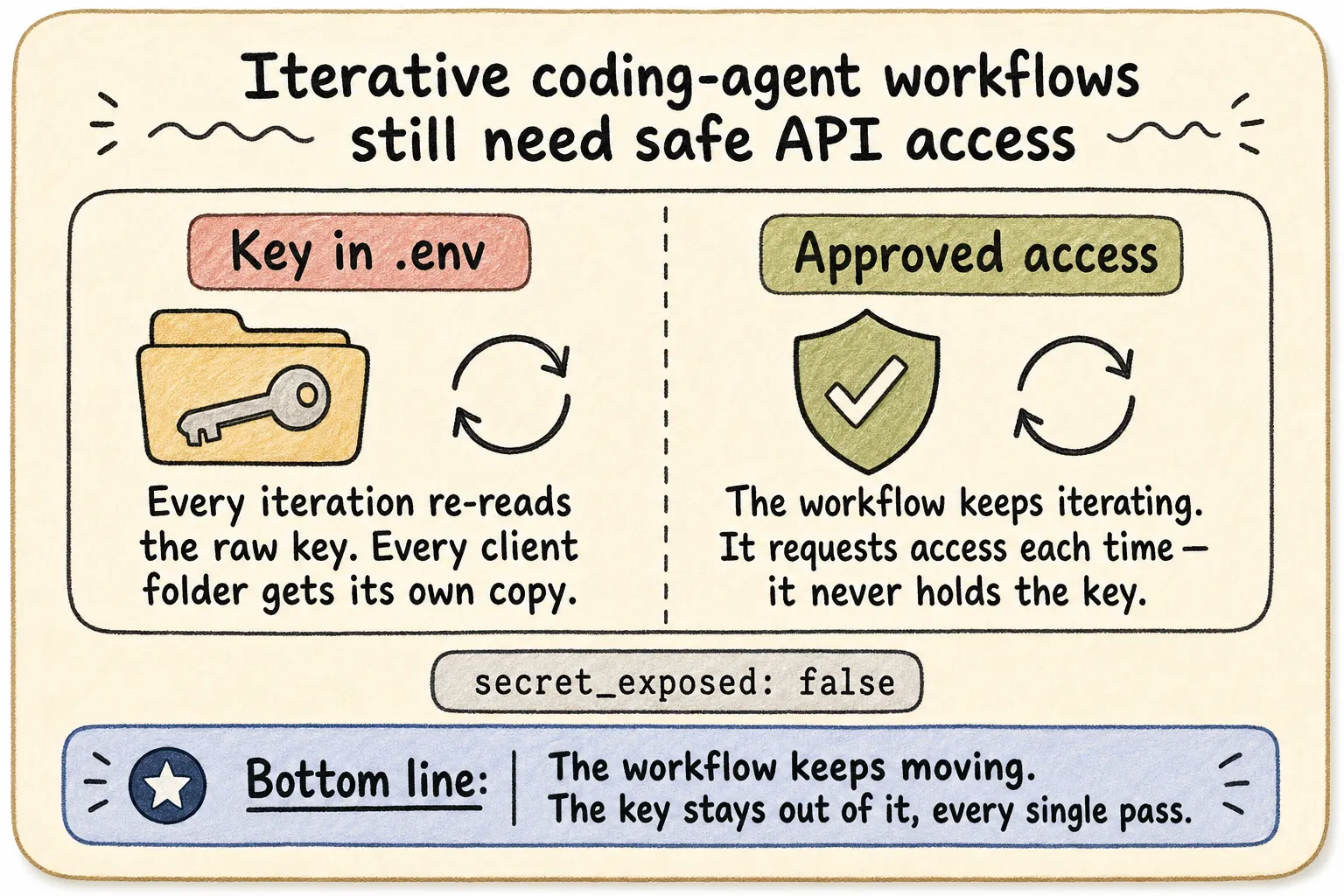
The question is how they get access. A raw key in .env or a prompt puts the secret inside a workspace the agent can read, run, and log from. A local runtime access layer lets the workflow request an approved action instead, so it keeps iterating while the key stays out of .env, prompts, terminal output, and generated files.

Outloop is built for iterative coding-agent workflows like Claude Code; it does not claim official platform support beyond what is verified. Claude Code is an independent tool — names and logos belong to their respective owners.
Claude Code workflows are becoming more autonomous
Coding agents like Claude Code increasingly run multi-step, iterative workflows — make a change, run it, read the result, fix, repeat — rather than answering one prompt and stopping. That is great for productivity, and it puts the same pressure on credentials that any agent loop does. (This is about iterative workflows in general — not a claim about any specific built-in command.)
Why API access still matters
An iterative workflow that can't reach real systems can't finish real work. So it calls APIs — and each call needs a credential. The naïve answer is to hand the agent a key; the better answer is to let it use access it never has to hold.
Why .env is the usual workaround — and why it fails across clients
Dropping the key in .env is the fast fix. But a
coding agent can read files, run shell commands, and write logs, so the raw key is now exposed inside the
workspace — and across many client workspaces it gets copied folder after folder.
Why .env files break down for agents ·
Claude Code API key: setup, risks, and the safer pattern.
Safer pattern: a local runtime access layer
Instead of a key in .env, give the workflow a
local access path: it requests an approved action, a broker uses the credential on the wire and returns a
redacted result, and the secret never enters the project. The loop keeps iterating; the key stays out of
prompts, terminal output, and generated files.
How Outloop fits for multi-client teams
Outloop is the local-first runtime access layer for exactly this: agents request approved access, secrets stay local, wrong-tenant calls are blocked, and every attempt is audited. For teams running coding agents across many clients, that means iterative workflows keep moving without per-project key copies — see Outloop for AI agencies.
Outloop is available with guided onboarding for agency teams; the Mac app is signed with a Developer ID and notarized by Apple, and release v1.1.6 was verified on two Macs on 24 July 2026. See the security model.
Agents should keep working. Humans should stop pasting keys.
Outloop is available with guided onboarding for AI agencies, operators, and dev shops.
Start 14-day trial