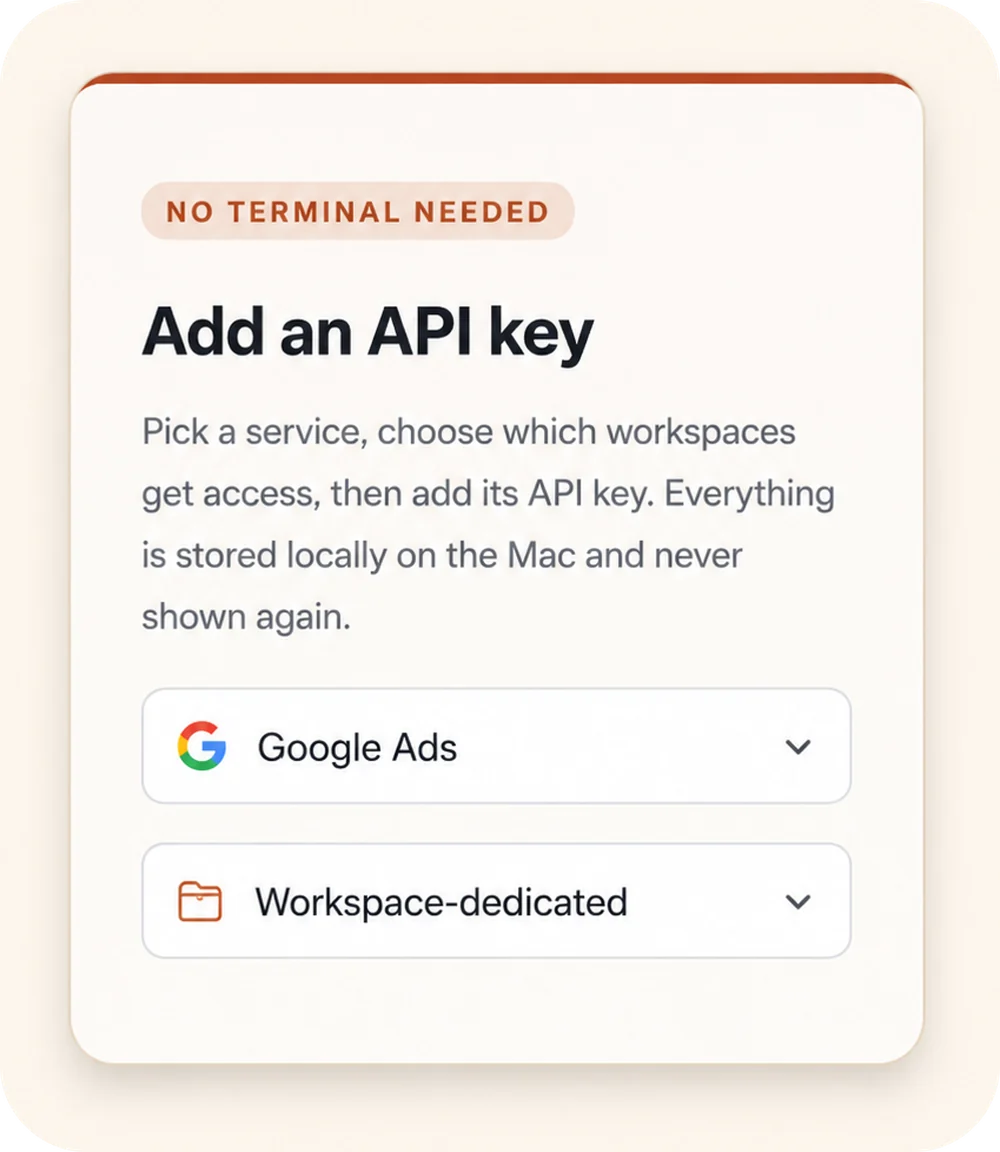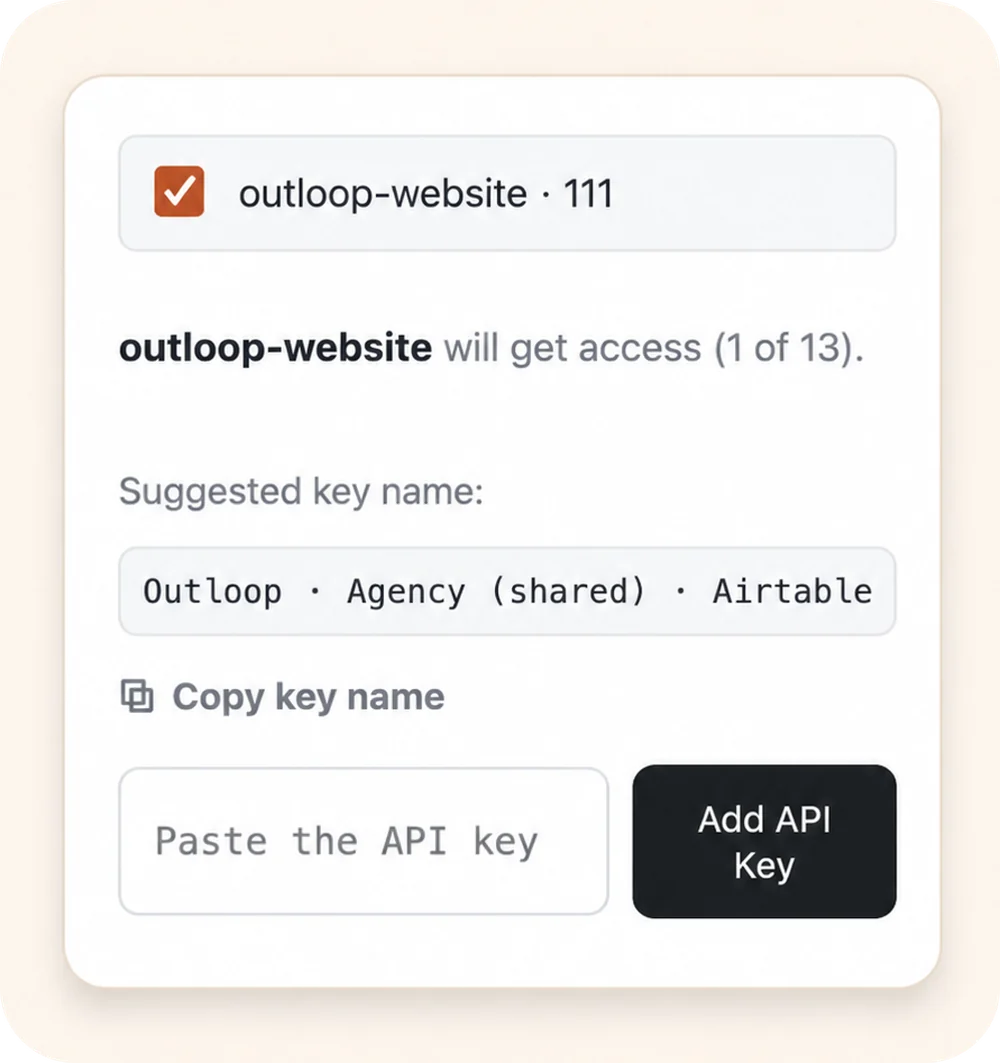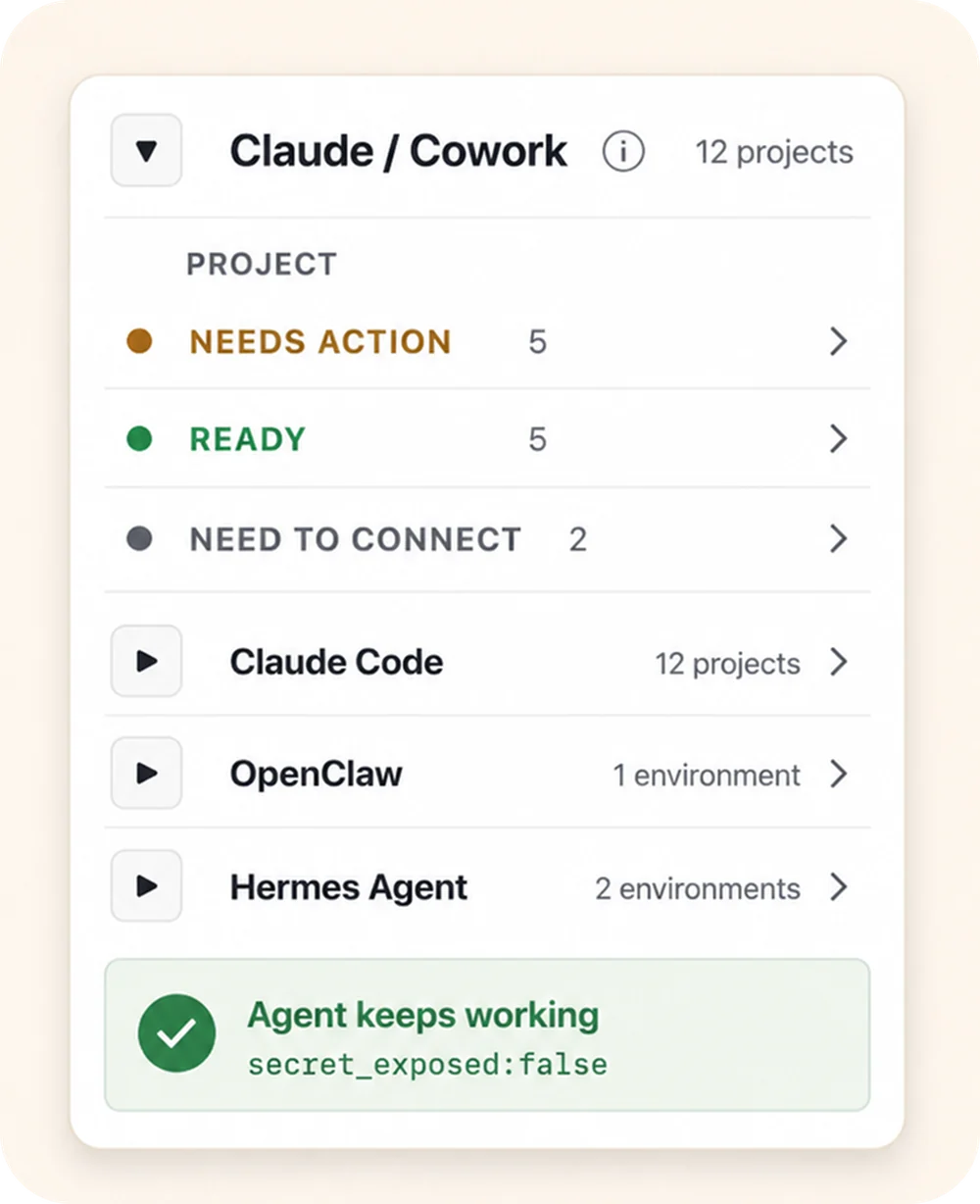




Your agents need API access to do real work — read a CRM, send an email, trigger an automation, pull a report. The problem is not that they need access. The problem is how that access is granted today: a human pastes a raw key, and from that moment the secret lives somewhere the agent can read it, copy it, or leak it.
This guide walks through why the usual approaches — pasting keys, .env
files, and even a proper secrets manager — break down once agents work across many clients, and what
a runtime access layer does differently.
It is never one key. It is every workspace that needs one.
A single agent reaching a single API is a solved problem. Real multi-client work is not that. Every client is its own agent operating environment — its own instructions, skills, scheduled tasks, sandbox limits, and access rules. Each new workspace re-introduces the same question: how does this agent reach that API safely?
So operators end up copying keys, creating .env files,
duplicating setup notes, and re-explaining the same access rules — once per client, then again per skill and per
scheduled task. That does not scale, and every copy is another surface a secret can leak from.
Three ways people manage agent keys today — and where each breaks
1. Paste the key into the agent
The fastest fix and the most fragile. Once a raw key is in the chat, it is in the transcript, often in logs, and sometimes in the wrong client's context. The agent now holds a secret it has no reason to hold.
2. Put keys in .env files
.env works when one developer runs one app. It breaks when
an autonomous agent can read files, run shell commands, write logs, and work across many client folders — and when
the same key gets copied into folder after folder.
Why .env files break down for agents →
3. Pull the key from a vault at runtime
Better for storage — and you should absolutely keep a vault. But a vault answers a request by returning the secret value to the caller. With agents, the caller is the process you are trying to protect against. Storage is solved; runtime use is not. Why a secrets manager isn't enough →
The shift: from owning the key to requesting the action
All three approaches share one assumption — that to use an API, the agent must hold the key. A runtime access layer drops that assumption. The agent asks for an approved action, not a credential. A local broker checks policy, uses the credential on the wire, and hands back a redacted result. The capability is used; the secret stays local.
A useful way to put it: if your agent can read your API keys, your trust boundary is in the wrong place. This pattern — a local decision point that applies the credential on the agent's behalf — is increasingly called a credential broker for AI agents; Outloop's name for its implementation is an agent access router.
The stakes are measurable. GitGuardian found Claude Code-assisted commits leaking secrets at roughly twice the baseline rate (3.2% vs 1.5%, State of Secrets Sprawl 2026), and Gartner — as cited by WorkOS — predicts that by 2028, 90% of organizations that let humans share credentials with AI agents will need significant investment to undo that design. Sources and more numbers: AI agent credential leak statistics.
How a request flows when the agent never holds the key
- 01
Agent request
The agent asks for an approved action or alias — not a raw key.
- 02
Policy & tenant check
Outloop checks project, tenant identity, and runtime policy before anything runs.
- 03
Local broker
On approval, the local broker uses the credential on the wire to perform the call.
- 04
Redacted result
The agent receives a sanitized, non-secret result. Raw values never enter its context.
- 05
Audit log
Every attempt is written to a redacted local audit — decision, tenant, service.
The agent never sees the credential. A wrong-tenant request is denied at the policy check, before any backend call.
That single change addresses the whole pain chain at once:
- ✓Agents request actions, not raw keys — so they stop asking you to paste one.
- ✓Secrets stay local in your existing backend; no raw keys scattered across project files.
- ✓Wrong-tenant access is blocked by policy before any backend call runs.
- ✓Every attempt is written to a redacted local audit — one trail across every client.
Keep reading
- →Why .env files break down when AI agents work across clients
- →Why "just use a secrets manager" isn't enough for AI agents
- →Managing API keys across many AI agent workspaces
- →How to hide API keys from AI coding agents
- →In practice: call tracking workflows without plaintext API keys (anonymized real workflow)